


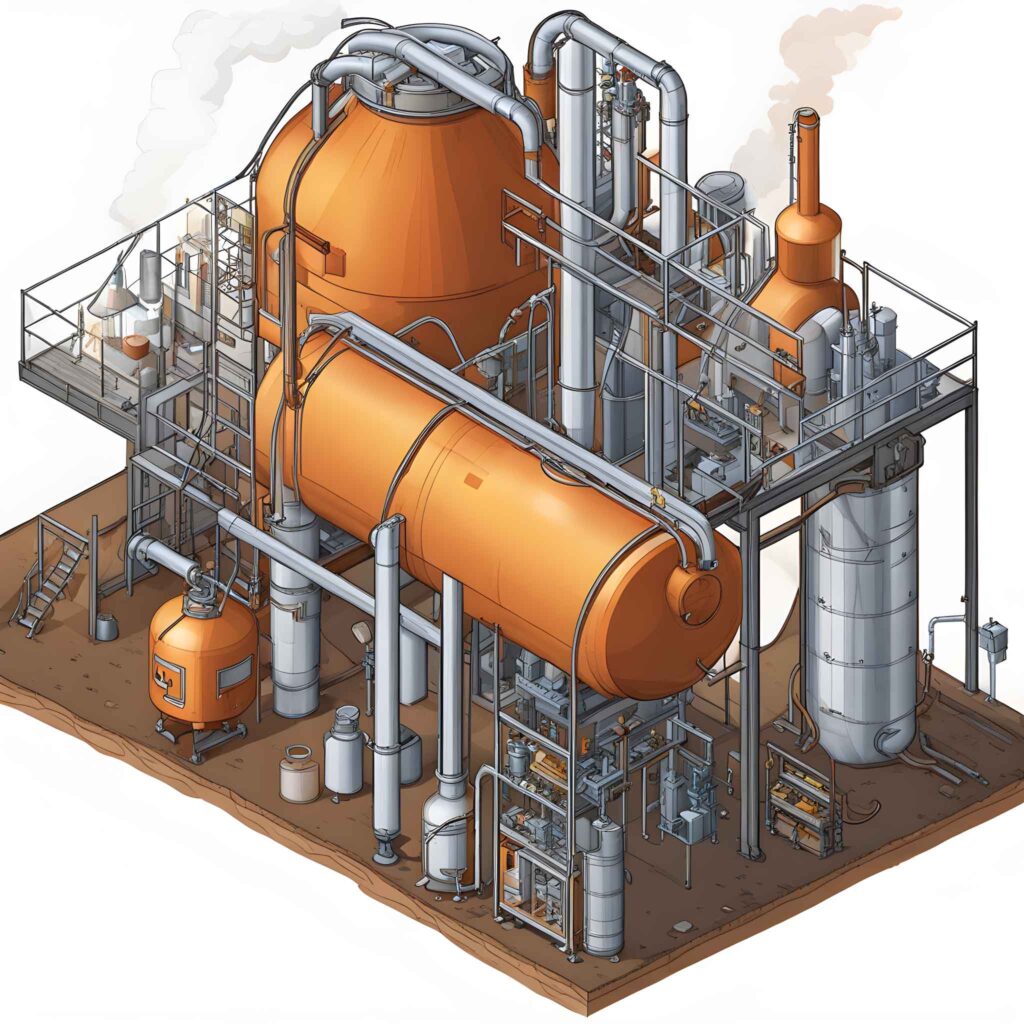
Pyrolysis Process: An Overview
Pyrolysis is a thermal decomposition process of organic materials at high temperatures in an environment with minimal or no oxygen. This method differs fundamentally from combustion, which requires a substantial amount of oxygen to occur. In this process, the absence of oxygen prevents the complete burning of materials. It is leading to the production of valuable by-products instead of just heat and carbon dioxide.
This process breaks down complex organic compounds into simpler substances. It is producing a range of products such as biochar, syngas, and bio-oil. The diversity of this process allows it to be adapted for various feedstocks, including biomass, plastics, and tires. Each type of pyrolysis—fast, slow, and flash pyrolysis—has specific operational conditions and applications, impacting the quality and quantity of the final products.
Wood vinegar is a liquid by-product of slow pyrolysis of wood and the other lignocellulosic raw material . This liquid, rich in organic acids and phenols, has applications in agriculture, husbandary, and the other industries . Understanding the nuances of pyrolysis helps in optimizing these processes for various industrial and environmental benefits.
The Products of Pyrolysis
Pyrolysis is transforming biomass into various valuable products. Biochar is its primary output, a carbon-rich material that can enhance soil fertility, sequester carbon, and serve as a sustainable alternative to traditional charcoal. However, this process also generates significant amounts of gases and liquids, expanding its utility beyond just solid biochar.
During the process, the biomass breaks down into a mixture of gases, including hydrogen (H2), methane (CH4), carbon monoxide (CO), carbon dioxide (CO2), and various other hydrocarbons (CnHm). Many of these gases can be condensed into a liquid form known as pyrolysis oil or bio-oil. They have potential applications as a renewable fuel or chemical feedstock. Despite this, not all gases produced are condensable; some remain permanent gases, such as CO2 and H2, which can provide the heat necessary for the process itself.
The proportions of biochar, bio-oil, and gases produced during the process are influenced by several factors: the type of biomass used (such as wood or agricultural waste), the size and moisture content of the feedstock, and the specific process parameters like temperature, pressure, and residence time. By optimizing these variables, pyrolysis can be tailored to maximize the production of desired products, making it a versatile technology for waste management, energy production, and environmental sustainability.
Different Types of the Process
Pyrolysis has three main categories depending on the desired outcome and the specific conditions applied: slow, fast, and flash pyrolysis. Each type differs in its process parameters, such as temperature, heating rate, and residence time, leading to different product distributions and applications.
| Products | Heating rate | Residence Time | Temperature (°C) | Process Type |
| Gases Char Pyroligneous acid, Tar | Low | Long Minutes to days | Medium – High 400-600 | Slow Pyrolysis |
| Bio-oil (thinner) Gases Char | High | Short Seconds to few Minutes | Medium – High 500-700 | Fast Pyrolysis |
| Gases Bio-oil | Very High | Very Shorts Seconds and even less | Very High 700-1000 | Flash Pyrolysis |
Slow Pyrolysis: The Carbonization Process and Its By-Products
Slow pyrolysis, also known as carbonization, is a process that occurs at lower temperatures. In this process heating rate is slow and residence time is long. This method is particularly effective in maximizing the production of biochar.
Wood vinegar or pyroligneous acid is of one of the primary by-products of the slow process. This reddish-brown to yellow acidic liquid is produced during the thermal decomposition of wood and other biomass materials. Wood vinegar has a variety of uses including as a natural pesticide, soil amendment and organic fertilizer in the farming, as a feed supplement in the husbandry, as smoky falvor in the food industry, etc.
Another notable by-product is tar, a dark, oily substance that separates from pyrolysis liquids through sedimentation. Tar itself can be further processed into two distinct fractions: tar pitch and tar oils. Tar pitch is a more viscous material often used in industrial applications, while tar oils can be refined for use in the chemical industry. These by-products not only add value to the process but also offer a range of practical applications across different industries.
Fast Pyrolysis: Optimizing Bio-Oil Production
Fast pyrolysis is a thermal process designed to maximize the production of bio-oil, a liquid fuel derived from the decomposition of lignocellulosic biomass. Operating at medium-high temperatures, it involves a short residence time and a high heating rate, though not as extreme as in flash pyrolysis. This precise balance of conditions facilitates the rapid breakdown of biomass into a liquid form, making it an efficient method for bio-oil production.
The bio-oil produced through this process is a versatile renewable fuel that can be used directly for heating, power generation, or as a feedstock for refining into higher-value chemicals. This process is particularly well-suited for processing lignocellulosic biomass, such as wood, agricultural residues, and other plant-based materials, which are abundant and renewable sources of energy.
By optimizing this type, industries can efficiently convert biomass into a sustainable liquid fuel, contributing to energy diversification and reducing reliance on fossil fuels. This technology holds promise for both energy production and waste management, offering a pathway to more sustainable energy solutions.
Flash Pyrolysis: A Rapid Pathway to Bio-oil and Biochar
Flash pyrolysis, also known as very fast pyrolysis, is a cutting-edge thermal decomposition process. It is characterized by extremely rapid heating rates exceeding 1000°C per second and reaction times that last only a few seconds or less. Due to this intense and swift heating, the feedstock material must be finely ground to ensure efficient conversion. The process is highly efficient, typically yielding around 60% biochar and 40% bio-oil and syngas, with the bio-oil being particularly notable for its high yield and low water content.
It stands out for its ability to maximize bio-oil production, making it a valuable technique in renewable energy and chemical industries. The bio-oil generated through this process is rich in energy. It can be used as a sustainable alternative to fossil fuels. The low water content in the bio-oil also enhances its quality, making it easier to store and refine. Meanwhile, the biochar produced can be utilized in various applications, including soil enhancement, carbon sequestration, and as a precursor for activated carbon.
There are several major types of flash pyrolysis, each with unique features and specific applications. These include Flash Hydro-pyrolysis, which incorporates hydrogen to enhance oil production; Rapid Thermal Process, designed for continuous industrial-scale operations; Solar Flash Pyrolysis, which uses concentrated solar energy as the heat source; and Vacuum Flash Pyrolysis, which operates under low pressure to optimize product yields.

Wood Vinegar: A Natural Byproduct with Multifaceted Applications
Wood vinegar, also known as pyroligneous acid, is a by-product of carbonixation of wood and the other lignocellulosic raw materials. Several factors influence on the composition and the quality of the wood vinegar. For instance, hardwoods and softwoods can yield different chemical profiles, affecting the final product’s properties. The temperature of the process also plays a critical role. Indeed, process with higher temperatures generally produces a vinegar with stronger acidic properties. These variations in production result in a versatile product that can be tailored for specific uses.
Wood vinegar has garnered significant interest for its wide-ranging applications, particularly in agriculture. Its organic composition and eco-friendly nature make it an attractive alternative to synthetic chemicals. Additionally, wood vinegar’s preservative and antimicrobial properties have found uses in various industrial processes, from the food industry to the wood treatment. As research continues, the potential for wood vinegar in sustainable practices and industries is likely to expand, making it a valuable resource in the quest for environmentally friendly solutions.


I’ve been browsing this site for a while now—always impressed with the
content quality.
Thanks so much! I’m really glad you’ve found the articles engaging—your support truly motivates us.